
Table of Contents
- The 150-Minute Dinner Window
- Book Backwards from the Next Stop
- Read the Deposit Terms Before Paying
- Match the Menu to the Table Time
- Set Group Expectations Before Arrival
- Protect the Move After Dinner
- A Six-Person South Kensington Plan
The 150-Minute Dinner Window
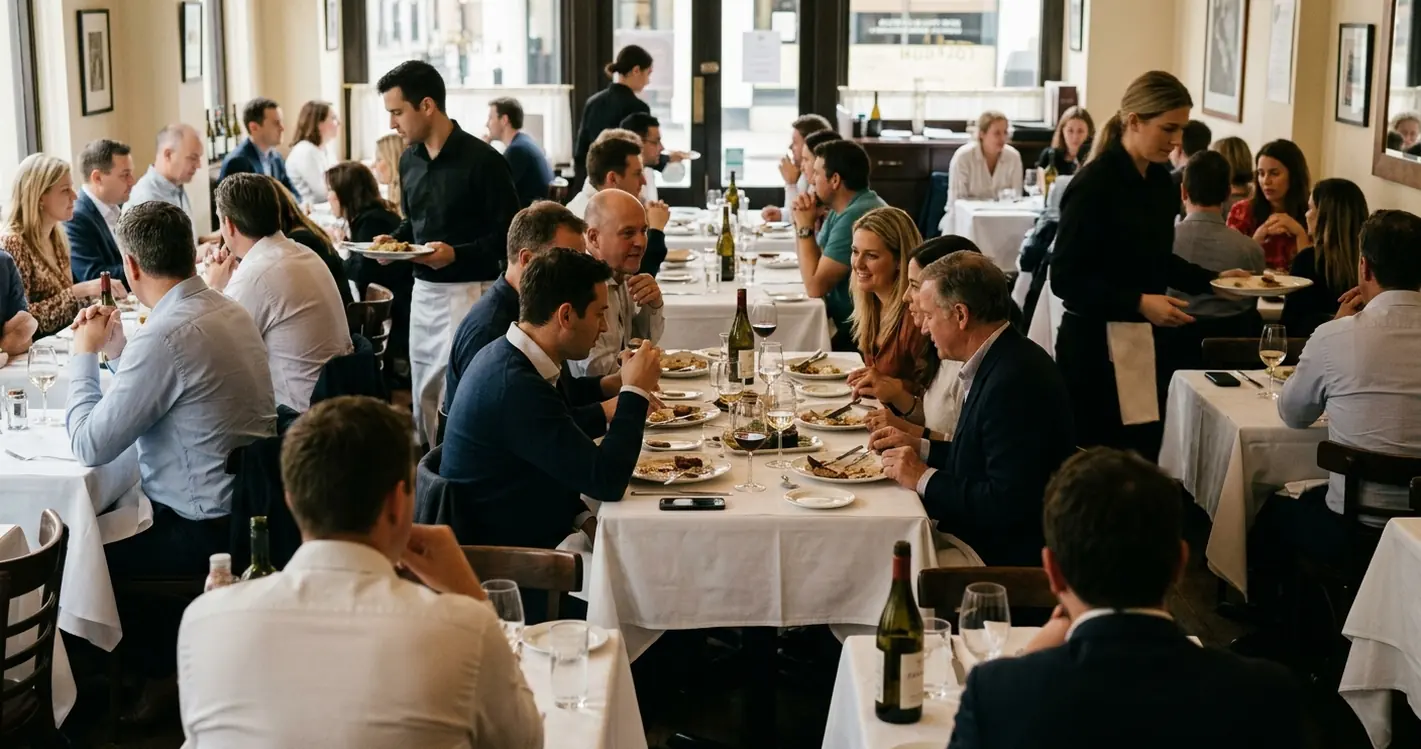
A 7:30 pm restaurant reservation followed by a 10:00 pm ticketed event creates a total operating window of 150 minutes. That block must absorb arrival, seating, ordering, dining, payment, coat collection and the journey to the next venue.
On paper, two and a half hours can look generous. In practice, only part of it belongs to dinner. A host who treats 7:30 pm as the start of an isolated restaurant booking may discover too late that ordering took longer than expected, the bill arrived after dessert, or six coats remained downstairs while the onward queue continued to grow.
The more reliable approach treats the reservation as the operating plan for the entire evening. The organiser starts with the least flexible commitment: a theatre curtain, live music & events ticket, guest-list deadline, club entry condition or final admission time. Every preceding decision then works backwards from that point.
The Fixed-Time Test
Before confirming a table, the organiser should ask which part of the night has the smallest tolerance for delay. Restaurants may offer some flexibility during quieter services, while a ticketed event or controlled entry period generally has a hard boundary. That boundary determines the sensible dining time.
Protect the Clock
Use the 10:00 pm commitment as the anchor. The 7:30 pm table only works when the menu, payment method and route can all fit inside the resulting 150-minute window.
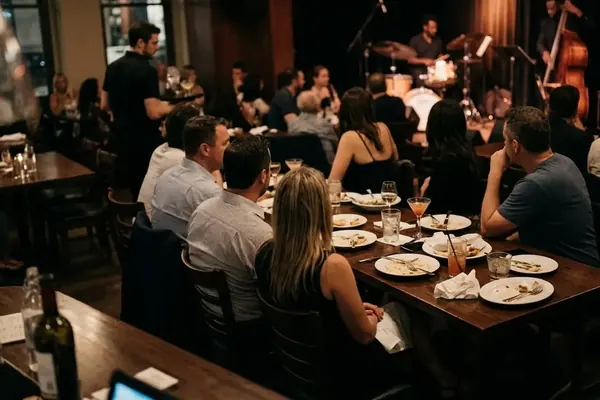
This framing is particularly useful in south kensington nightlife, where dinner, cocktails & bars and event venues may sit close together yet operate under separate entry rules. Physical proximity reduces travel time; it does not remove queueing, payment or collection delays.
Book Backwards from the Next Stop
The first time entered into the plan should be the absolute onward deadline rather than the preferred dinner slot. If a venue requires arrival by 10:00 pm, that condition governs the sequence.
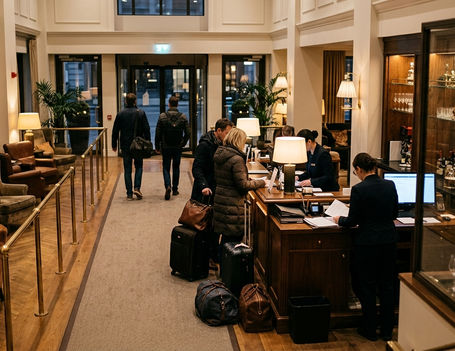
From there, the organiser subtracts realistic allowances for queueing and transit, then coat collection and bill settlement, and finally the meal itself. Within South Kensington, a destination may fall inside a 10- to 15-minute walking radius. The route still needs checking at the relevant time of night, particularly when the party includes slower walkers, accessibility requirements or several people carrying coats and bags.
Early Table or Late Table?
An earlier sitting creates recovery capacity. If one guest arrives late or the kitchen pauses between courses, the evening can continue without immediately threatening the next booking. The atmosphere may initially feel quieter, but the group gains time for another drink and can leave in a controlled way.
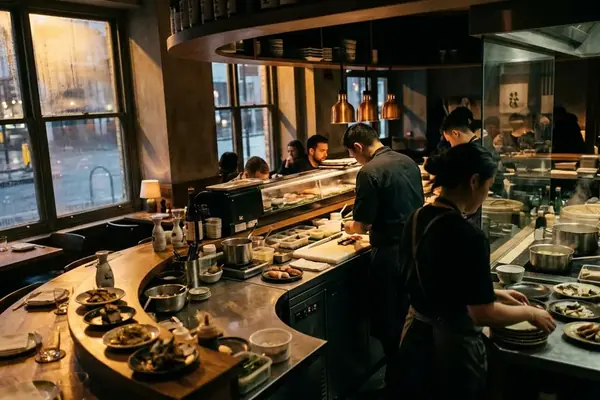
A later table often captures a livelier dining room. It also compresses the exit. The attraction is understandable for a night built around sushi & dining or a high-energy restaurant, yet atmosphere has to be weighed against the onward entry condition.
- Choose the earlier sitting when the next stop has ticket scanning, a queue or a strict guest-list deadline.
- Consider the later sitting when the next venue is flexible and the restaurant forms the main event.
- Reject the sequence when the proposed timings leave no usable margin for payment and coats.
A practical plan assigns roughly 15 to 20 minutes to settling the bill and retrieving outerwear. That period is operational time, even though it no longer feels like dining. Reserving it at the planning stage prevents the final course from becoming an improvised countdown.
Read the Deposit Terms Before Paying
Reservation checkouts use several payment mechanisms that carry different consequences. A refundable deposit, a non-refundable booking charge, card details held against cancellation and a minimum spend should each be read on its own terms.
A deposit may be deducted from the final bill, returned after attendance or retained separately under the venue’s policy. Card details may secure the booking without an immediate charge, then trigger a fee after a late cancellation, reduced party size or no-show. A minimum spend sets a required level of expenditure and can apply even when guests order less.
Four Clauses to Capture
- Record the cancellation deadline and the time zone or service period to which it applies.
- Check whether reducing the party size attracts a charge.
- Confirm the treatment of late arrivals and complete no-shows.
- Establish whether any deposit will be deducted from the final restaurant bill.
Standard cancellation windows commonly fall between 24 and 48 hours. A grace period of about 15 minutes before table release can also apply. Enforcement tends to be tighter during peak Thursday-to-Saturday evening services; early-week bookings may carry slightly more operational leniency, though the written terms remain the controlling record.
Keep the Receipt
One organiser should retain the confirmation email, payment receipt and exact policy accepted at checkout. Screenshots can help when key conditions appear inside a booking flow rather than in the final email.
The lead booker can then decide whether to place the reservation on a personal card and collect funds later, or request transfers before the cancellation cut-off. That choice matters for a six-person table because one absence can otherwise leave the organiser carrying a charge that the group never discussed.
Match the Menu to the Table Time
A stated return time defines what the table can reasonably accomplish. It influences the number of courses, the pace of drinks, the space for speeches and the amount of choice available at ordering.
Groups of four to six commonly encounter table return times of 90 to 120 minutes. A three-course à la carte service requires at least 120 minutes, so a shorter allocation immediately narrows the viable format. Trying to preserve every possible choice inside a compressed service window transfers pressure to the kitchen, waiting staff and guests.
Choose the Format Deliberately
À la carte dining gives each person control, but six separate decisions can lengthen ordering and create uneven preparation times. It suits a generous table allocation and a group capable of choosing promptly.
A set menu reduces the decision tree while preserving individual course choices. Sharing menus simplify the table further and often fit sociable evenings built around cocktails & bars, although the organiser should check portioning and dietary separation. Pre-orders provide the greatest timing control because the venue can prepare for the table before arrival.
- À la carte: appropriate when the restaurant is the principal destination and the table has at least the required service time.
- Set menu: useful when the group wants multiple courses with controlled ordering.
- Sharing menu: effective for cohesive groups whose dietary requirements are already known.
- Pre-order: strongest for a fixed onward deadline or a larger table moving into south kensington nightlife.
Pre-ordering reduces decision time and kitchen complexity. Substitutions, allergies and other dietary requests still need direct confirmation from the venue; a note in a group chat does not alter the restaurant’s service record.
Course-Time Fit
If the booking carries a 90-minute return time, the menu must reflect 90 minutes of service. Speeches, birthday presentations and an extra cocktail round consume the same finite allocation as food.
Set Group Expectations Before Arrival
The organiser should issue one precise assembly time between 15 and 30 minutes before the reservation. That message also needs the full restaurant address and a direct contact number for the person holding the booking.
Giving guests only the seating time encourages staggered arrival. One person reads it as the time to enter the restaurant; another treats it as the time to reach the nearest station. A separate assembly time absorbs routine transit variation before it begins to erode the table allocation.
Information Needed Before the Deadline
- Dietary requirements and ingredient allergies
- Mobility, seating or other accessibility requirements
- Non-drinking preferences relevant to packages or minimum spend
- Confirmed attendance and any likely change in party size
- Agreement on the selected menu and payment arrangement
Last-minute additions can exceed the table configuration or invalidate a pre-order. Unannounced absences may expose the lead booker to a per-person charge. Late arrivals create a different problem: the venue may retain the original return time even when the full party sits down after it.
For brunch, a delayed arrival may simply shorten a relaxed daytime meal. During peak evening service, the same delay can remove a course or force payment while plates are still being cleared. Communicating the consequence in advance usually works better than sending repeated messages once the host is already at the restaurant.
Protect the Move After Dinner
The bill belongs inside the schedule. Waiting until the planned departure time to request it places the entire onward journey at risk.
A cleaner sequence requests the bill while final drinks or desserts are being cleared. This overlaps administrative work with the end of service. Split payment across multiple card terminals can require around 10 to 12 minutes purely for processing, before the group has resolved who owes what.
Agree How the Table Pays
One payer with later reimbursement creates the fastest exit when the group trusts the arrangement. Agreed subgroups, such as three pairs, can also limit terminal handling. A venue-approved split works when the restaurant has confirmed both the number of payments and its preferred procedure.
Unlimited individual transactions should never be assumed. Some dining rooms restrict splits during busy service, while others can divide by an agreed amount but will not itemise every dish at the table. The organiser should ask before arrival and place the answer in the shared plan.
Departure also needs a physical check. Coats, umbrellas, gifts, shopping bags and phones can remain under chairs or at the cloakroom. A return journey for one missing item can consume the entire walking buffer.
Doorway Check
Before the group exits, one person confirms payment, cloakroom items and the route to the next venue. The check takes moments and closes the restaurant stage cleanly.
A Six-Person South Kensington Plan
Consider six diners with a fixed requirement to reach a ticketed event at 10:00 pm. Their restaurant reservation is 7:30 pm, and the intended restaurant departure is 9:25 pm. This leaves 35 minutes for transit and queueing.
Illustrative Running Order
- Assemble early: the organiser gives the group an arrival point before the 7:30 pm seating time, using the established 15- to 30-minute buffer.
- Sit promptly: the host checks in with the complete party and confirms the recorded dietary requests.
- Order to plan: the six diners use a pre-agreed set, sharing or pre-order format rather than opening a fresh menu discussion.
- Start payment early: the bill is requested while the final course is being cleared.
- Leave at 9:25 pm: the group completes a belongings check and begins the onward journey with 35 minutes available for walking and queueing.
The organiser places four operational details in one shared message: confirmed seating duration, deposit treatment, dietary requests and payment method. The same message includes the restaurant address, assembly time and onward deadline, giving all six guests one current version of the evening.
The avoidable failure point is a six-way payment discussion that begins after dessert. At that stage, card limits, itemised calculations and missing transfers compete directly with the departure time. A single payer or pre-arranged split removes that table-side negotiation.
At 9:23 pm, the final card receipt reaches the organiser while the last glasses are cleared. Six coats come down together, one guest checks beneath the banquette for a phone, and the group steps onto the South Kensington pavement at 9:25 pm with the event tickets already open.





Add Your Thoughts