
Table of Contents
- Introduction
- Before You Book
- Arrival, Queues and the Door
- Ordering Without Looking Lost
- Sharing the Bar Space
- Dress Codes, Phones and Photos
- Paying, Service Charge and Tipping
- Leaving Well
Introduction
London cocktail bar etiquette is mostly awareness: reading the room, respecting the staff, and keeping the evening smooth for the people sitting within earshot.
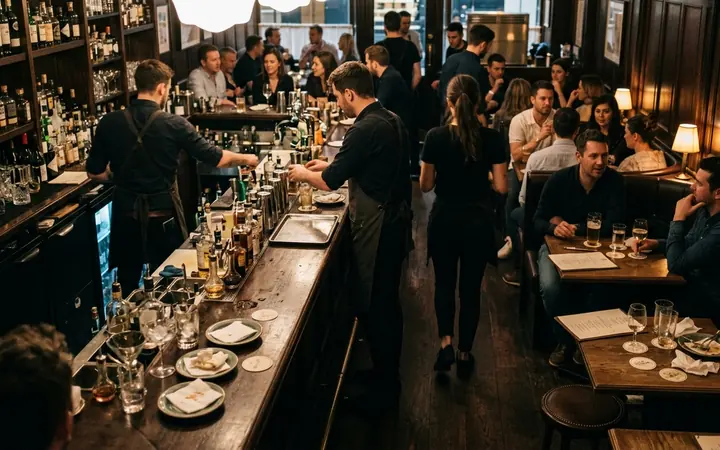
I have watched excellent nights go slightly sideways not because anyone ordered the wrong martini, but because a group missed the rhythm of the room. A bartender mid-shake is not ignoring you. A host holding the rope is not being theatrical. A low-lit lounge in South Kensington works on small calibrations: where coats go, when a round is ordered, how loudly a table celebrates the second drink.
The editorial team initially considered treating this as a strict rulebook, then moved toward situational awareness after seeing that most friction in upscale venues comes from misreading the moment. That matters for first-time visitors, students, date-night planners, and groups moving between dinner, shisha, cocktails, and late-night venues across central London.
This is not stiff fine-dining protocol, and it is not generic party advice. It is polished, practical etiquette for seated London cocktail bars, especially the sort of room where table service, lighting, music, and pacing are part of the experience.
Key Takeaway: You do not need encyclopaedic drink knowledge to look comfortable in a good cocktail bar; you need timing, clarity, and a little spatial awareness.
Before You Book
Book the room you actually need
Reservations matter in London cocktail bars because the best rooms are not just filling seats. They are balancing pre-theatre drinkers, after-dinner guests, date-night tables, and late arrivals who want to linger over one last round.
Venue management typically structures reservation grids around those pressure points. Thursday to Saturday evenings are the obvious peak, but theatre-adjacent hours and the slots just after dinner can be just as tight. Some venues hold back a small fraction of tables for high-spend walk-ins only when the room layout and staffing can support it, so assuming a walk-in will work is a gamble, not a plan.
Book for the real group size. If four becomes six, tell the venue. If six becomes three, tell the venue. A table plan is a piece of bar infrastructure, and changing the numbers at the door forces the host to solve a geometry problem while the queue watches.
Check the house rules before you travel
Look for deposits, cancellation windows, table time limits, dress expectations, and walk-in policies on the booking page. Cancellation windows typically range from a day to a couple of days before the reservation. Table time limits are frequently capped at around 90 to 120 minutes for groups of two to four guests.
Holding multiple tables at different bars might feel like sensible insurance, but it damages the evening for everyone else. The venue blocks stock, staffing, and seating around expected covers. If you need flexibility, choose one booking and keep a second venue in mind for walk-in only.
Pro Tip: If you are planning drinks after dinner, book the cocktail bar for the time you will realistically arrive, not the time you hope the restaurant bill appears.
Arrival, Queues and the Door
Make the host’s job easy
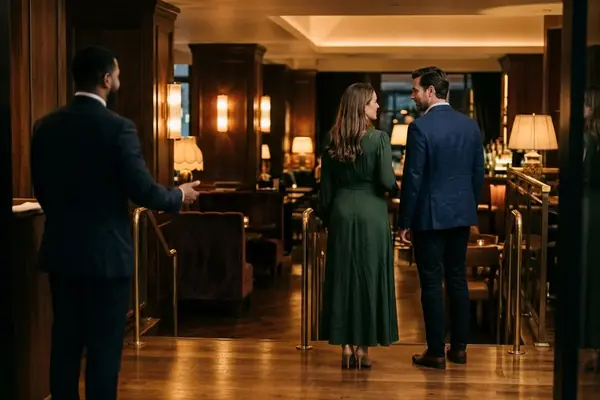
Arrive with the booking name, time, and group size ready. Say it clearly. Then give the host a moment to check the screen, look at the floor, and decide the cleanest route through the room.
Door hosts are trained to assess group cohesion during the initial greeting. Complete parties are easier to seat than fragmented groups because they reduce bottlenecks at the host stand and stop half the party drifting into the bar while the rest are still outside.
The common beginner mistake is treating the door as a negotiation. The better approach is to treat it as the first service point. Calm, direct, and prepared usually gets you further than charm deployed at high volume.
If you are early, late, or incomplete
If you arrive early, wait nearby rather than crowding the entrance. If you are late, call ahead. Grace periods for late arrivals generally span around 10 to 15 minutes before the table is released to the waitlist, especially on busy nights.
The failure case is familiar: a group of six arrives 20 minutes late without calling, their table has been given to walk-ins, and the door team has no spare configuration left. At that point, arguing rarely changes the room’s capacity.
Queueing etiquette in London is simple. Stay together, do not push forward, and do not send one person to hover by the host while the rest of the group blocks the pavement. If the room is at capacity, accept it. Capacity is not a mood; it is a licensing, safety, and service issue.
Warning: A booking confirmation is not a licence to arrive whenever you like. On peak nights, the grace period is part of the booking, not an optional courtesy.
Ordering Without Looking Lost
Read the menu by structure, not ego
A cocktail menu becomes easier once you stop pretending to know every ingredient. Scan by spirit, flavour, strength, and style.
Ask yourself four questions. Do you want gin, whisky, rum, tequila, vodka, or something lower in alcohol? Do you want citrus, bitter, herbal, smoky, creamy, or sparkling? Do you want something short and strong, or long and refreshing? Do you want a drink that opens the night or slows it down?
That is how many bartenders hear an order anyway. They mentally sequence drinks by build: stirred drinks, shaken drinks, highballs, clarified serves, carbonated pours, garnishes, glassware, and ice. A standard round of four complex cocktails takes roughly 4 to 6 minutes of active preparation time, so clarity at the start helps the whole station move.
Useful language for beginners
You do not need to say, “Surprise me,” unless you genuinely accept the risk. Better language sounds like this: “something citrus-led and not too sweet,” “a stirred whisky drink,” “a low-ABV option,” or “something bitter but not too heavy.”
Those phrases give the bartender enough sensory direction without trapping them in a recipe quiz. In our review of upscale ordering habits, the most comfortable guests were not the ones with the most jargon. They were the ones who described preference cleanly and then let the bartender work.
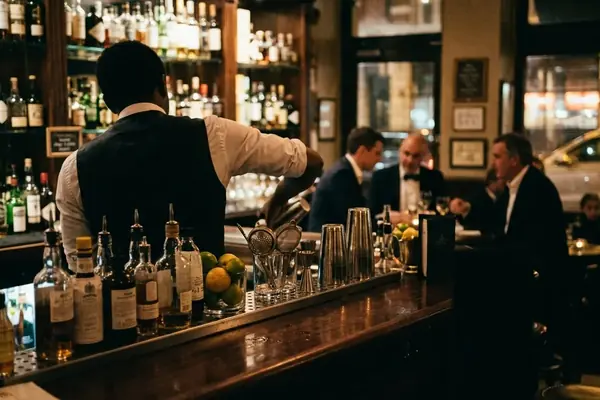
Ask questions during quieter moments or once the bartender has acknowledged you. Do not interrupt active service, especially when tins are moving, glassware is being pulled, or a tray is being checked. That is not snobbery. It is concentration around sharp tools, wet surfaces, and hot handovers.
Sharing the Bar Space
Respect the invisible map
Every good cocktail room has an invisible map. You can feel it if you watch for thirty seconds: where servers pass, where trays are loaded, where guests pause, where the bar team reaches for garnish and glassware.
Floor staff map out service corridors between the bar and lounge seating. Guests who block those paths force servers to reroute, which subtly slows the whole room. Service stations usually need a clearance radius of around 1.5 metres for staff to manoeuvre trays safely, so the empty-looking patch beside the bar may not be empty at all.
Avoid leaning across service areas. Do not rest coats and bags on empty stools without asking. If one person can order for the group, send one person, not the entire table.
Match the voice level to the room
A refined hotel bar, a members’ club-style lounge, and an intimate basement cocktail room all have different acoustics, but none improve when one table decides to perform.
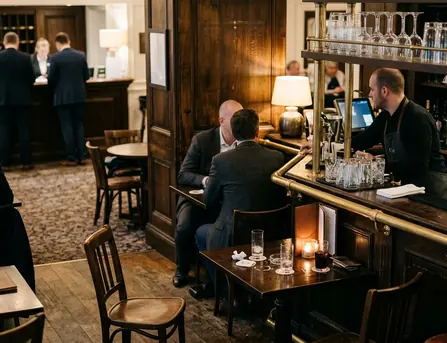
Keep the celebration at your table, not across the room. If the music is low, lower your voice. If the bartender has to lean in every time you speak, simplify the order rather than shouting over the rail.
This is where etiquette becomes generosity. You are buying drinks, but you are also sharing atmosphere with strangers who may be on a first date, talking business, or nursing one immaculate negroni after a long service of their own.
Dress Codes, Phones and Photos
Dress for intention
London dress codes vary sharply by venue. Beginners should check the booking page and aim slightly smarter for upscale cocktail bars, particularly in South Kensington, Mayfair, Chelsea, and traditional hotel settings.
Management teams frequently update door policies as fashion changes. Many have moved away from strict garment bans and toward a broader judgement of whether an outfit looks polished and intentional. That said, sportswear, beachwear, and overly casual items can still get refused elsewhere.
Clean, minimalist trainers are widely accepted in some modern South Kensington cocktail bars, but the same footwear may cause a problem at a traditional hotel bar just a few streets away. Context does the deciding.
Use the camera carefully
Phones are part of the night now. A quick photo of the drink, the table, or the room is usually fine if you are discreet.
Keep calls brief. Avoid speakerphone. Do not film staff or other guests without permission. Flash photography is often restricted entirely later in the evening in low-lit lounge environments because it breaks the atmosphere the venue has spent all evening building.
If the room feels cinematic, enjoy that without turning it into a set. The best bars in London are designed to make people feel slightly more elegant than they did on the pavement outside. Let other guests keep that illusion too.
Paying, Service Charge and Tipping
Read the bill before the table clock runs out
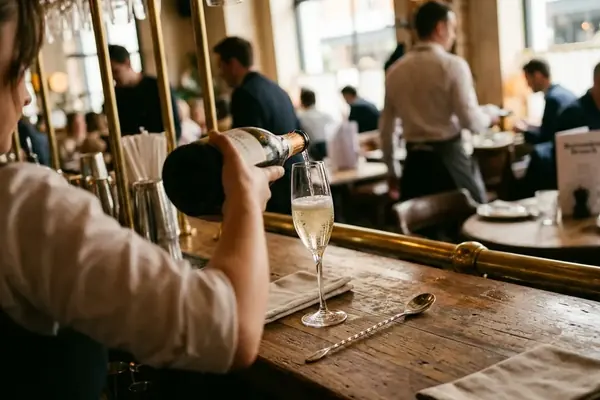
In many London cocktail bars, table service ends with an itemised bill. The bill may include a discretionary service charge, so check before adding anything else.
Point-of-sale systems are often configured to append discretionary charges because it speeds checkout during peak turnover windows. Discretionary service charges typically sit around 12.5% to 15% on the total bill. When service charge is absent, or when staff have given notably thoughtful guidance, tipping is appreciated but should still feel voluntary.
Do not wait until the server is standing with the card machine to start a six-way debate. Many venues restrict card splits to about three to four separate transactions per table, and some will not split complicated rounds item by item.
Make group payment boring
The smoothest groups decide the payment method before the bill arrives. One person pays and others settle later, or the table agrees on a simple card split.
What does not work well is auditing every garnish, side sip, and extra glass at closing speed. If someone ordered a rare spirit pour while everyone else drank spritzes, settle that fairly, but do it with the group rather than making the server referee the mathematics.
A calm payment is one of the clearest signs that a table knows how to use a grown-up bar.
Leaving Well
Know when the night is ending
End-of-night etiquette starts before the final sip. Settle the bill before the table time ends, collect belongings promptly, and leave the table in reasonable condition.
Security and floor teams often coordinate the room’s landing sequence by raising ambient light slightly and lowering music volume. Final drink orders are usually called around 20 to 30 minutes before the venue’s licensed closing time, so treat that call as a real marker, not an opening bid.
One catch: this guidance applies primarily to seated, table-service cocktail lounges. It does not translate neatly to high-volume, standing-room-only club environments, where speed of service dictates a much more direct ordering style.
Plan the journey home before the final drink
If you are visiting London, plan the route home before the last round lands. Tube lines, night buses, taxis, rideshares, and walking routes all feel simpler while you still have full attention.
For official routes and live transport options, use the Transport for London journey planner. It is less glamorous than another cocktail, but it is the difference between ending the night cleanly and negotiating with a dying phone on the pavement.
Leave well and the venue remembers the table for the right reasons. More importantly, your group keeps the night intact from the first greeting to the last door close.
Add Your Thoughts